Wednesday, November 11, 2009
Art Week~ Open studios in AA hall and a review of the week
Because i am part of the curatorial studies class i had the opportunity to see multiple studios open up for art week. It was really interesting especially to see the studio SMPs open. I think its often important to see works in process. It gives great insight into the building of a complete set of works. Most of the studio SMPs are still in the brainstorming process. Mary Gotschalk is working on a story based painting project. Montse is working with texture and i noticed beginning pieces that have female figures in them. I think it would have been neat if the smps had written descriptions or information about the projects. The professors additionally had their studios open. Sue Johnson, carrie Patterson, and Billy Friebele all had their studios open along with displays of their artwork. Carrie Patterson had a few of her pieces left over from Placing Color. It was really neat to see her work space, again giving insight into the development process of creating art. She had an entire station of brushes paint and a table full of blocks being prepared for a new art work. The visiting photography professor also had her studio open. Most of her work dealt with photographs from a different country. Most of the photographs were portraits and they exhibited the lifestyle of these people. In terms of artweek as a whole i think it was a major success. I hope it will continue to be a feature every semester. I think it really solidified the art department as a whole group and working entity. It also really created awareness of the different art projects and how important many of them are. I think it inspired people to maybe become more involved in the department. I really think its great that we have art events and lectures throughout the year. But, something like this, where we feature art in process or simply art theory, is just as important. It shows that art is important and interesting even when it isn't a finished product ready to be placed on a white wall in a sterile exhibition. It would be neat to try and incorporate other departments. I think this was attempted in the Professor Throwdown at the end of the week. That could really show how art is an integral part of other departments and the school as a whole.

Tuesday, November 10, 2009

Sunday, November 8, 2009
Artist Entry~ Sveriges Radio
I stumbled upon this piece of new media art through BetaSpace, a new media art source. The Title of the piece is Let Them Sing It For You. Basically it is a program in which you can type in any words of your choice. They can be a famous quote, your own words, or a sentence (or several). Once typing in your words you press the play button. Then, from a data base of songs, the program will "play your words". Essentially it is a database full of words taken from songs. So, for instance, one might put in the word "never" and the database will play "never" from some song that they took that word from. I tried out this program. From the website there was little to no information about the program so i had no idea what the program was going to be. I was wondering who "they" were. I entered the words, "How is this art? Can you tell me please? Is it because you use appropriation? Good luck finding that word in your database." And sure enough the program played my words through a bunch of words from songs...but, of course, appropriation was not found. The program used a series of words that, when placed together, sort of sounded like appropriation. There really isn't any writing on this piece of art so i'll make my own assessment. I think this piece of new media art is amusing at best. The most apparent thing to me is that it definitely uses appropriation. I think one thing that is interesting about this is that music is a huge part of culture, especially popular music, which is where most of the words come from. Another interesting thing is that even though each word has its own melodic sound the final piece that is played doesn't sound like music. It is disjointed and maybe even unsettling to listen to. I think this piece could be highlighting how music is created and how one cannot simply string together what makes up a library of popular music and create a new song.
Thursday, October 1, 2009
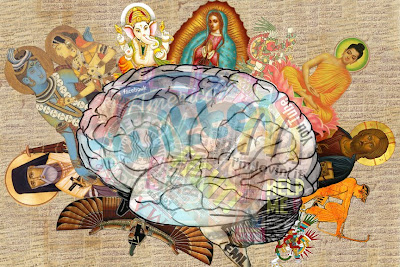
BEFORE CRITIQUE


Changes: I made the hindu god on the left a little bit darker blue so that he didn't blend in so much with the twitter symbol. Additionally, I faded out the edge of the twitter image a little bit. Then, i added a few more religious symbols to cover the spaces on the bottom. However, it was really hard finding different images. I think i actually prefer the before image.
Wednesday, September 30, 2009
THE END OF TELEVISION: ARTIST ENTRY
THE END OF TELEVISION was a broadcasted artistic event. Essentially the event occurred when all televisions in the united states switched from analog television to a digital transmission. This change caused the analog televisions to become obsolete, however, Ian Page and a collaboration of artists found this change as a significant and useful time to collaborate and broadcast their own art. After the switch from analog to digital these artists broadcasted their own art on the analog signal within the Pittsburgh area. So, according to Rhizome, The End of Television was the only broadcasting program on Analog television at that time. I see this art piece as a type of appropriation. The artists appropriated the free space that the now obsolete analog television provided. Additionally, this art work is making a statement about the role of television in our lives. When you think about it, during the time of the switch there must have been a few people watching T.V. on analog televisions. They would have been watching a regularly broadcasted program and then suddenly would be thrust into viewing new media art in place of their regular program (i.e. a sports game). Additionally, there is this idea that many people had already switched to digital and so as THE END OF TELEVISION is playing and describing the pitfalls of T.V. millions of people will miss this program as the now obsolete and empty analog rambles on. I think this project is a great use of the empty space that analog would be taking up, and i think its neat to broadcast different new media artists' work. However, i think it would be great if the program continued...but because analog is obsolete now the artists' work might not be viewed. I also thought it was interesting that the program had pieces of art that highlighted problems with our society's habits of watching T.V. I think this should have been the essential part of the broadcast. It would be interesting if there was a posted video of the entire broadcast.
There is one part of the broadcast that caught my attention. The program featured a group called HiTEC, 5 mins into the video, which reminds me of a lot of the noise we here and see on television. I'm not sure if that was the intention of that part of the program.
Monday, September 21, 2009
ARTIST ENTRY~Maurice Benayoun
Maurice Benavoun created World Skin, a Photo Safari in the Land of War. This is a highly interactive art installation. Essentially viewers enter the art space where they can interact with a virtual reality. The viewers move through space comprised of frozen pictures of war scenes, which creates one giant war space. The viewer is instructed to "take pictures" with the "camera" provided. Every time a viewer "takes a picture" the subject of that picture becomes a white silhouette within the virtual reality space.
In this art work, Maurice Benavoun is commenting on photography's power in redefining space, events and people. I think he might be saying that photography essentially strips away the original essence of an event or person and makes that person or event more tangible to the person who took the picture. However, even though photography makes that event/person tangible to the photographer the event itself or the person him/herself become less connected with reality because now they are only associated with the photographs.
I think that Benavoun chose a war scene as the main environment for the art exhibit because there are many startling and memorable, emotional moments that come from war photography. However, i think his intended message becomes lost because of the intensity of war. I believe that the subject of war itself outshines the idea of taking photographs and essentially owning the moment. Although, it could have been his intention to chose a emotional subject matter, such as war, thus in the process of taking photos and stripping those moments away we are stripping away the realness of war and making it tangible and less frightening through photography. Also, the virtual landscape is rather eire because of the combination of the stillness and the seriousness of the photographs.
Monday, September 14, 2009
Artist Entry~ ACCESS
ACCESS by Marie Sester is a piece of installation art that truly blends the boundaries between internet, real time as well as modern day technology. This installation is one of many that address the qualities of surveillance systems that are ever present in todays modern world.
The public installation can be found in Karisrue Germany. Essentially, anyone with an internet connection can log onto the ACCESS HOME PAGE and interact with the installation. Upon entering the installation via internet, internet users can track individuals that walk into the installation space. The individuals are unaware that they have walked into the installation. The web user can track the individual by following them with a beam of light that receives information from the internet user. Additionally, the individual will hear targeted audio. The sounds that the individual hears are only audible to the individual.
This is any interesting project because it is a commentary on surveillance and the boundaries of privacy. My initial response to this project was that it sounded a little bit like invading privacy. But overall, the public has responded positively to the project. I mean, how neat is it that we can actively interact with people all the way over in Karisrue, and visually see their reaction to our actions?! I also think its neat that this installation creates a dialog between the person on the internet and the person in Karisrue. The installation is therefore worldwide. Not only does it stay in Karisrue where it is visible to multiple individuals walking through its space, but it is also brought into the homes of millions world wide. This is one of my favorite things about digital art. It bridges the gap between real time interaction, space, internet technology all the while commenting and giving a new perspective to the technologies (ie, surveillance, internet) we use everyday!
Subscribe to:
Posts (Atom)

